
Guest experience
Interactive Wedding Guest Experience Ideas That Earn Their Line Item
A working guide for planners and detail-obsessed couples: the 2026 guest experience vendor field, from audio phones to drone shows, sorted by per-guest cost, what guests actually do versus watch, and what’s left when the trucks leave.
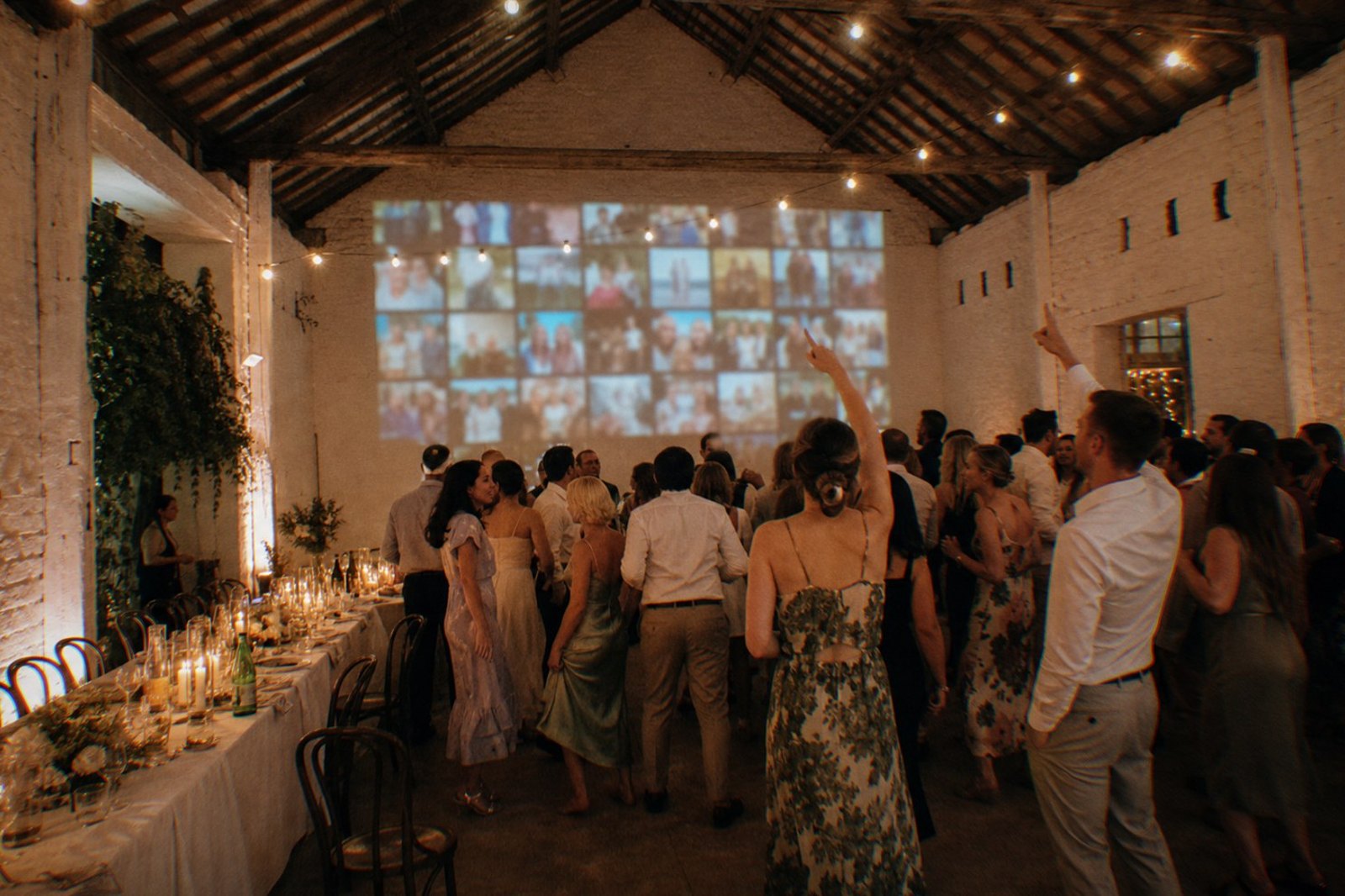
Twenty years in the NFC business taught me a rule that transfers surprisingly well to weddings: at any event, the technology people remember is the technology that made them do something. Nobody leaves a conference talking about the projection mapping. They talk about the thing they tapped, wore, voted with, took home. Weddings, it turns out, obey the same physics, and the vendor market has finally noticed.
Guest experience has climbed to the top of couples’ stated priorities in planner trend surveys over the last few seasons, and an entire vendor category has bloomed in response: audio guest books, 360 video booths, live painters, wedding content creators, cold-spark machines, drone shows. Planners now assemble experience stacks the way they once assembled vendor teams for florals and catering. What I rarely see, from either planners or couples, is a sorting principle better than “what looked great on the last wedding’s reel.” So here’s the one I use, plus the honest field guide.
Sort by what guests do, not what it costs
Every guest-experience idea on the market splits cleanly into two piles.
Spectacle: guests watch it. Drone shows, cold sparks, projection, live painters (guests watch the painting happen; one person keeps it). Spectacle photographs beautifully, hits hard for ninety seconds, and produces content. It is also passive by definition: the guest’s role is audience.
Participation: guests produce something. Photo and 360 booths, audio phones, polaroid stations, group games, shared albums, tap-to-share bands. Participation is what guests bring up a month later, because memory encodes what we did far more durably than what we saw.
Neither pile is wrong; a great reception often has one spectacle beat. But when budget forces a choice, participation wins, and inside the participation pile the differentiator is capacity: how many of your guests can the experience actually process in one evening?
The 2026 field guide, with the numbers that matter
Prices below are the typical ranges I see planners quote in 2026; treat them as ballparks for budgeting conversations, not quotes.
| Experience | Typical cost | Do or watch? | Capacity per evening | The artifact afterward |
|---|---|---|---|---|
| Photo booth / 360 booth | $500 to $1,500+ | Do | Queue-limited, roughly 30 to 60 guests | Clips and strips, mostly of the queue-tolerant |
| Audio guest book phone | A few hundred (rental) | Do | Announcement-driven, a fraction of the room | Audio files; the phone goes back |
| Live painter | $1,500 to $4,000+ | Watch | Everyone watches, one output | One painting for the couple |
| Content creator | $1,000 to $3,000 | Watch (being filmed) | Whole room, passively | An edited reel |
| Drone / spark show | $1,500 to $10,000+ | Watch | Whole room, 5 minutes | Footage |
| Live photo wall + shared album | Varies by method | Do | The whole room, in parallel | The couple’s full gallery |
| Named NFC band per guest | $17.50 to $19.50 per guest at 100 | Do | Every guest, all night, no queue | Gallery for the couple, keepsake per guest |
The capacity column is the one planners feel in their bones but rarely see written down. A booth is a wonderful thing with a throughput problem: one group at a time, three minutes a cycle, and the introverts never queue at all. An audio phone collects what the MC’s announcements push toward it. Anything station-based is, structurally, a bottleneck with décor. The experiences that reach the whole room are the ones running in parallel on every guest’s own phone or wrist, which is why the bottom two rows behave differently from everything above them.
The per-guest experience: where favors and AV merge
The newest thing in the field isn’t a new station; it’s a pricing model. Stations price per event. The emerging category prices per guest, which changes how it scales and whose budget line it lives on.
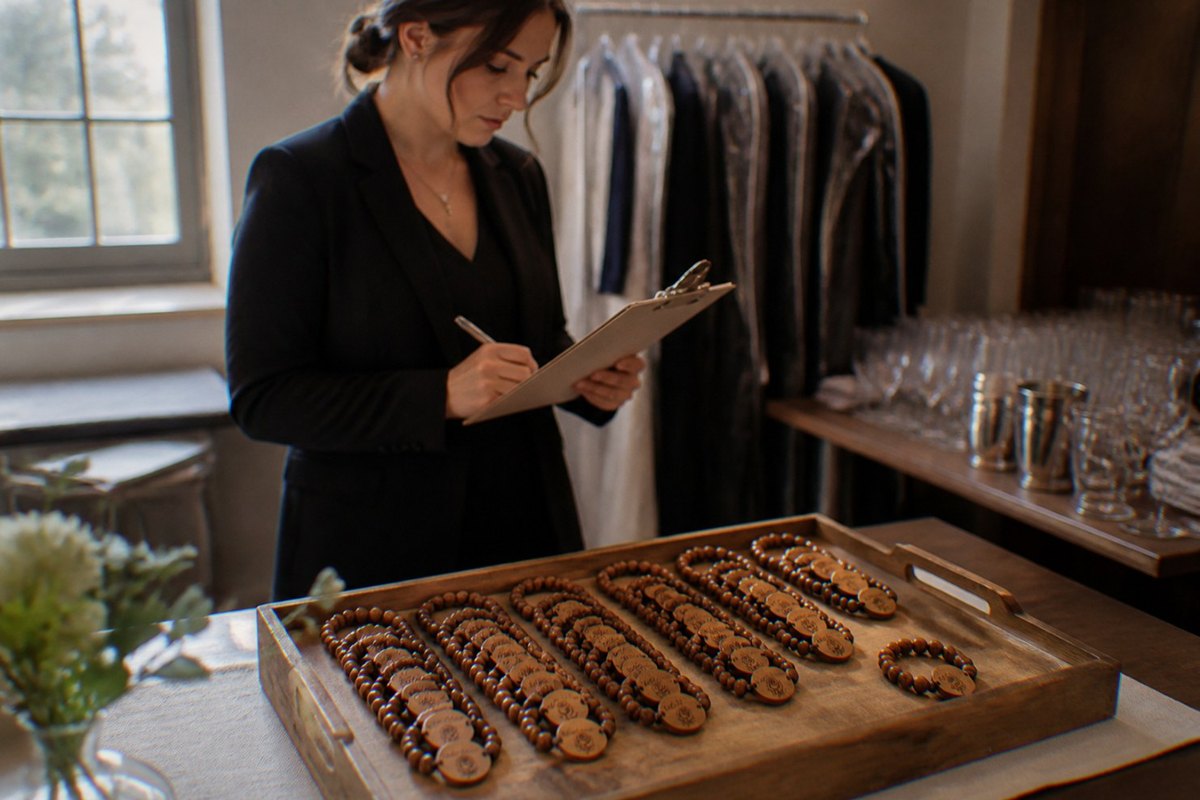
Our bands are the version I can speak to with real numbers, so, founder’s hat on. Each guest gets a cotton or beaded band with their name engraved on a wooden tag, which quietly retires the escort-card printing job. The NFC chip inside turns every band into a key to the couple’s private album: one tap with any phone, no app, and the guest is adding photos and wishes from their seat, the dance floor, the after-party. Feed the album to a screen and you have a live photo wall that the guests themselves are programming all night, the participation loop that no booth’s throughput can match. And at the end, the band leaves on the guest’s wrist as the favor they actually keep.
The planner-relevant mechanics: pricing is a published tier table, $17.50 cotton or $19.50 beads per band at 100 guests, falling to $12 to $14 at 500 and beyond, so bigger weddings get cheaper per head, the opposite of most experience lines. Minimum order is 5 bands, which is how several planners we work with sample the product before putting it in front of couples. Design happens in a browser-based 3D configurator, bead by bead, and every order generates a digital engraving proof the couple approves before paying anything, which for a planner means no invoice fights over a misspelled cousin.
The honest limits, same hat: it’s favor-budget money times your whole guest list, it needs the couple to want guest photos (some genuinely only want the pro’s), and the band must fit the wedding’s look, which is the whole reason the configurator exposes the actual materials instead of a logo printer.
Composing the stack: a planner’s cheat sheet
For a typical 100-guest reception with a real but finite experience budget, the compositions I see work:
Under $500: skip stations entirely. One well-run shared album with table-card prompts, plus late-night food. Participation on the food budget’s coattails.
$500 to $2,000: one participation anchor that reaches the whole room (bands and a live wall, or a booth if the couple loves the strip aesthetic), plus one small spectacle beat at the exit.
$2,000 to $5,000: whole-room participation anchor, one premium station (audio phone or booth), one spectacle moment. Resist buying a second spectacle; nobody remembers two.
Whatever the tier, apply the artifact test before signing anything: when the trucks leave, what does the couple hold, and what do the guests hold? Ideas that answer “nothing, but it looked incredible” belong in the video budget, not the experience budget.
The guest experience trend is real, but it’s being sold as a shopping list when it’s actually a design problem: a hundred people, five hours, and the question of whether they spend it as an audience or as participants. Spend on the ideas that put something in guests’ hands, that run all night without a queue, and that leave both sides holding evidence in the morning. That’s the whole playbook. The rest is decoration.
Questions couples ask
What counts as guest experience at a wedding?
Everything a guest touches that isn’t food, ceremony or seating: how they find their seat, what they do between dinner and dancing, what they take home, and whether they end up in the story of the night or just in the audience for it. The budget line covers both hired experiences, booths, performers, and per-guest objects like favors that do something.
How do you make a wedding interactive without making it gimmicky?
Use the one-job rule: every interactive element should produce something the couple genuinely wants, photos, messages, a keepsake, rather than activity for its own sake. A photo booth passes because it makes pictures. A cornhole set at a black-tie reception fails because it makes nothing but a queue. Gimmick is what’s left when the output is missing.
What do interactive wedding experiences cost in 2026?
Stations and performers price per event: photo and 360 booths, audio phones and live painters typically run from a few hundred to a few thousand dollars each. Per-guest experiences price per head: personalized NFC bands run $17.50 to $19.50 per guest at 100, sliding to $12 to $14 at 500 or more, which makes them one of the few experience lines that gets cheaper per guest as the wedding grows.
What’s the minimum order for NFC wedding bands?
Five bands, which covers proposals, planner samples and micro-weddings. Per-band pricing is highest at small quantities and steps down through more than twenty tiers as the count rises, with the full table published openly on the pricing page.
Do planners get anything out of recommending wearable photo bands?
A cleaner run of show, mostly: seat-finding is built into the band, photo collection runs itself without MC reminders, and the live wall gives the room energy without another vendor truck. The couple’s proof-before-payment flow also means the planner isn’t chasing revisions after money has moved.
