
Guest experience
Wedding Guest Book Alternatives Guests Actually Line Up For
Most guest books get signed by half the room and reopened once. Audio phones, Polaroid stations, thumbprint art and tap-to-share bands, compared by what guests really do at 9 p.m. and what you’re still holding in five years.
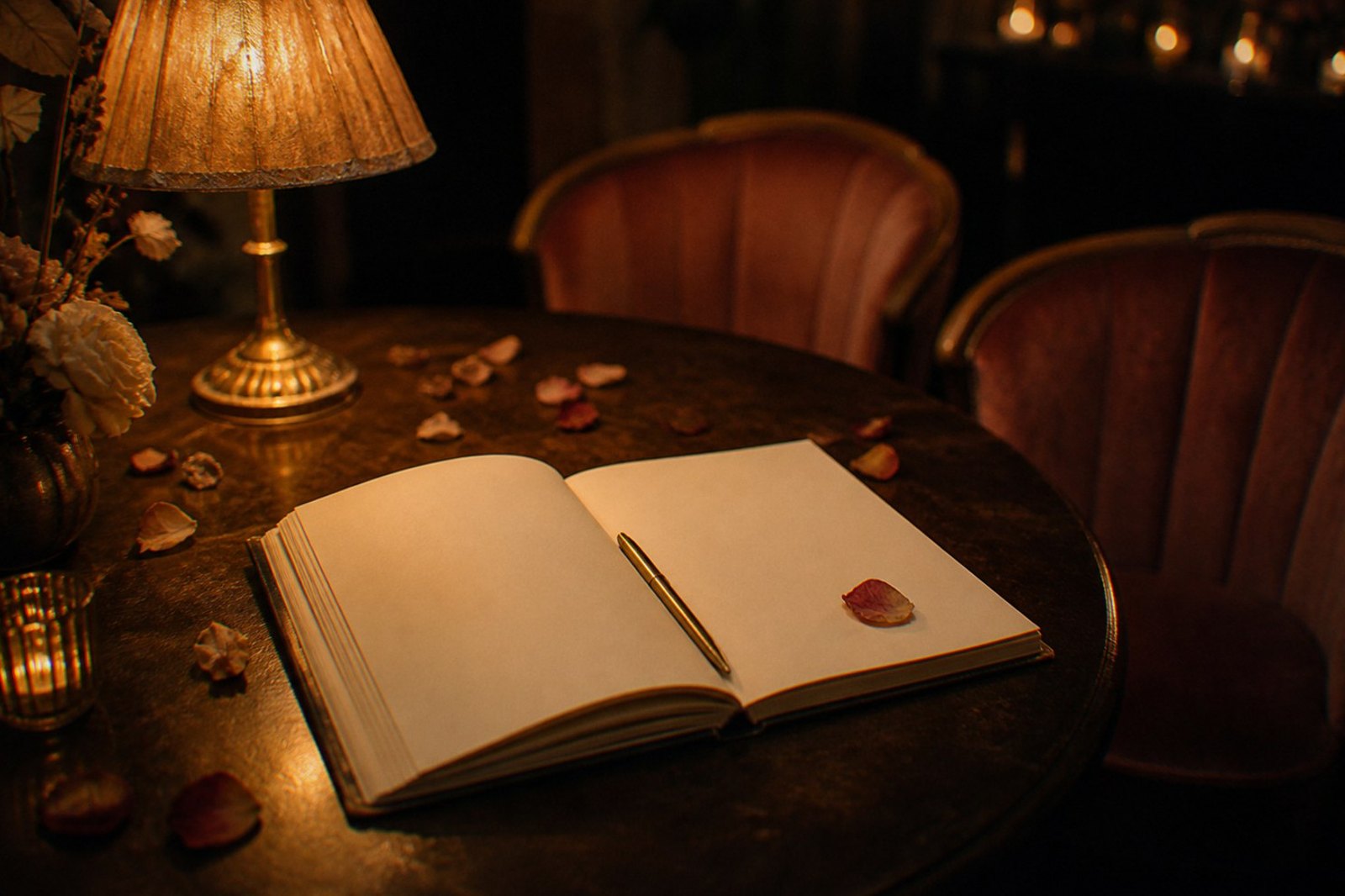
There’s a moment at nearly every wedding that explains why this article exists. It’s 8 p.m., cocktail hour is long over, and the guest book is lying open on the welcome table exactly where the planner staged it, pen capped, pages mostly cream. Half the room walked past it twice. The other half meant to come back. By the time anyone remembers, the band is playing and nobody is leaving the dance floor to go write a paragraph in the lobby.
Couples know this, which is why “guest book alternatives” is one of the most searched planning questions there is. But most lists answer it like a Pinterest board: thirty cute ideas, zero analysis of the two failures that killed the original. So let’s fix that first, because every alternative should be judged against them.
Why the traditional guest book fails
The book fails twice, at different times.
It fails at the wedding because it’s a station. It sits in one place, off the path between the bar and the dance floor, and it asks guests to stop, think of something original, and handwrite it while people queue behind them. Participation follows: a book from a 120-person wedding typically comes back with a fraction of the room in it, heavy on the guests who arrived early and light on everyone who mattered to the last four hours.
It fails after the wedding because it’s an archive with no trigger. Planning forums are full of couples admitting, a little sheepishly, that their guest book lives in a closet and has been opened once, the week after the honeymoon. There’s no moment in ordinary life that says “go re-read the guest book.” The object survives; the ritual around it never existed.
Any alternative worth your money has to beat one of those failures, and the great ones beat both.
The four families of alternatives, compared honestly
Every idea on every list sorts into four families. Here’s how they actually behave, at the reception and in year five:
| Alternative | Guest participation | Needs staffing or reminders? | What remains in five years |
|---|---|---|---|
| Audio guest book (vintage phone) | Medium, rises with MC announcements | Yes, announcements are load-bearing | Digital audio files (phone was a rental) |
| Art pieces (thumbprint tree, signed globe or frame) | Medium-high, it’s fast and visual | Light, needs a visible station | One display object on a wall |
| Polaroid or photo-booth book | Medium, queue-limited | Yes, film restock and a staffed corner | A physical album, often incomplete |
| Shared photo album (QR sign or link) | High for photos, low for written wishes | Yes, signage plus reminders | A digital gallery, if the service kept it |
| Tap-to-share band (worn, NFC) | High for photos and wishes | No, the prompt is on every wrist | The gallery plus a keepsake per guest |
A few honest notes on that table, because tables hide nuance.
Audio guest books earn their popularity. Hearing your grandmother’s voice years later is worth more than any signature, and no photo replaces it. Their weaknesses are practical: they rent for a few hundred dollars, the charming phone goes back to the vendor on Monday, and the recordings only happen if the MC pushes the room toward the phone two or three times. If voices matter most to you, book one and enjoy it; just know the announcements are part of the product.
Art pieces solve the shelf problem by being wall objects instead of closet objects. A thumbprint print gets hung; a book gets stored. Their ceiling is content: a thumbprint and initials is presence, not personality. You’ll know who came, not what the night felt like.
Photo-based options win on participation, full stop. Taking pictures is the only guest-book behavior guests already do voluntarily, hundreds of times per wedding. The whole design question is collection: getting the photos out of a hundred camera rolls and into one place. We’ve written a complete comparison of collection methods, and the short version is that every method lives or dies on friction and reminders.
The station problem, and the case for wearing the guest book
Look back at that table and notice what four of the five rows have in common: they’re all places. A phone on a stand, a frame on an easel, a booth in a corner, a QR sign by the bar. Every one of them asks guests to notice a station, walk to it, and do something there, which is why every one of them leans on announcements, signage, and a coordinator gently herding people all night. Participation is a logistics project.
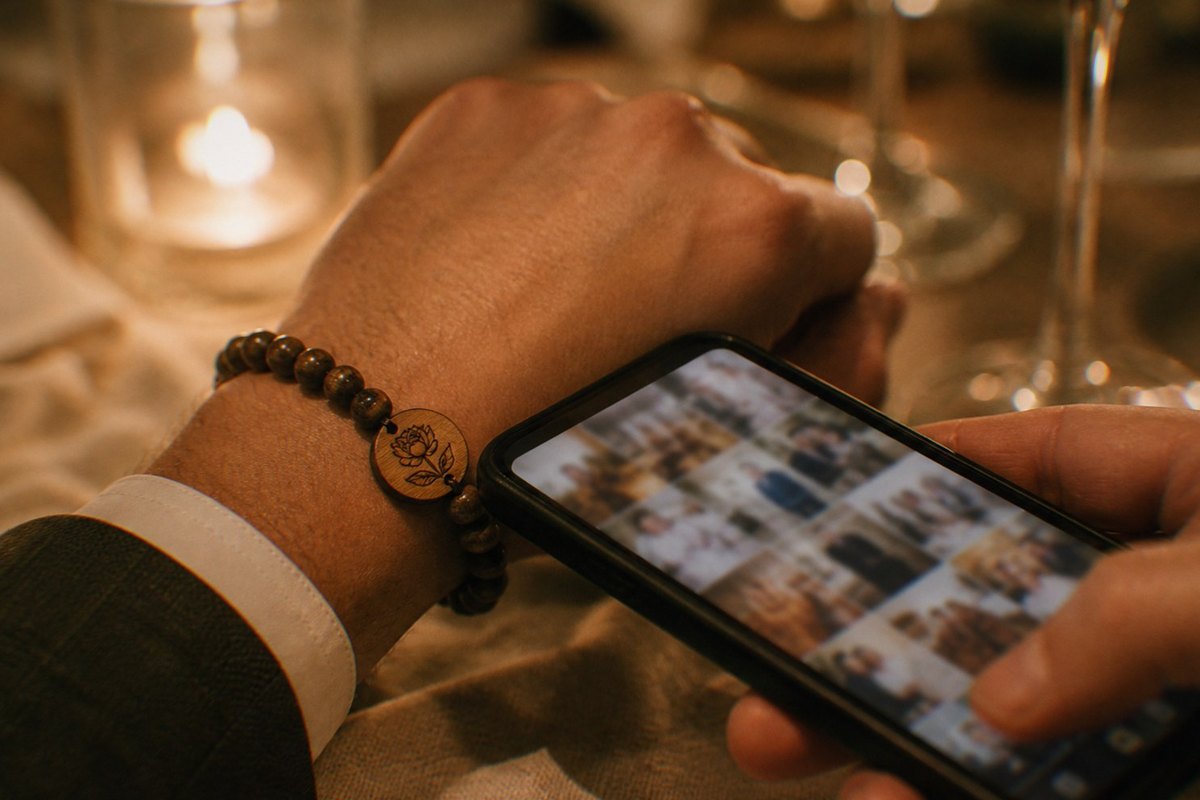
This is the specific problem we built our version to remove, so read the next paragraph knowing who’s talking. A WearableWedding band puts the guest book on the guest. Each band is a woven-cotton or beaded bracelet with the guest’s name engraved on a wooden tag and an NFC chip inside. Tap it with any phone, theirs or a neighbor’s, and the couple’s private album opens in the browser: add photos, leave a written wish, watch the night’s gallery grow. No app, no account, no QR sign that only works if people remember it exists. The prompt to contribute isn’t at a table in the lobby; it’s on a hundred wrists, all night, including at the after-party where the best material happens.
And because the band is also the favor and the place card, the guest-book budget stops being its own line item. Each guest keeps a named keepsake; you keep a gallery of every photo and wish, plus a live wall at the reception if you want the room to see itself in real time. At 100 guests the bands run $17.50 to $19.50 each on the pricing tiers, which is not a casual spend, but it’s competing with the favor line and the photo line at once; we walk through that whole-table math here.
The five-year test
Whatever you pick, apply one filter before paying: describe what you’ll physically or digitally have on your fifth anniversary, and how you’ll stumble into it.
A book: in a closet, found during a move. Audio files: in a folder, played when you miss someone, which is truthfully the strongest answer in this whole piece. An art print: on the wall, seen daily, saying little. A photo gallery: scrolled on anniversaries, if the service kept it alive, so check the storage terms before buying. A band: in a jewelry dish or still on a guest’s wrist, and every tap reopens the album, which means your guests keep a working key to the memory, not just a souvenir of it.
The traditional book fails the five-year test not because it’s paper but because nothing invites you back to it. Prefer the alternatives that build the return trip in.
A guest book was never really about signatures. It’s a headcount of the people who loved you enough to show up, taken in a form you can hold later. The book version asks guests to stop partying and write; the better versions collect the evidence while they celebrate. Choose the one whose five-year answer you like, and if that answer involves every guest wearing the key home, we’d love to show you what that looks like.
Questions couples ask
Do you still need a guest book at a wedding?
No, and skipping it is increasingly common. The guest book’s actual job is proof that the people you love were in one room. Anything that captures who was there and what the day felt like does that job, and several alternatives do it with far higher participation than a book on a side table.
What can I use instead of a wedding guest book?
The proven alternatives cluster into four families: audio (a phone guests record messages into), art (thumbprint prints, signed frames or globes), photo-based (Polaroid stations, shared albums, tap-to-share bands), and hybrid objects that collect both photos and written wishes into one private gallery.
How much does an audio guest book cost?
Most audio guest book phones rent for a few hundred dollars for the weekend, typically including the recordings as digital files afterward, and purchase-to-keep versions cost more. You’re paying for the novelty and the editing; the hardware is a vintage telephone with a recorder inside.
What is a digital wedding guest book?
A private online space where guests leave photos, videos and written wishes from their own phones, usually reached by QR code or NFC tap rather than an app. The good ones need no download or account, because every step you add costs you a share of the room.
What guest book alternative works for guests who hate writing?
Photo-first options. A guest who would never compose a heartfelt paragraph will happily add twelve candid photos to a shared album, and candids of your people mid-laugh usually age better than a rushed ‘congrats!!’ in ballpoint anyway.
