
place card favors
Place card favors your guests wear home.
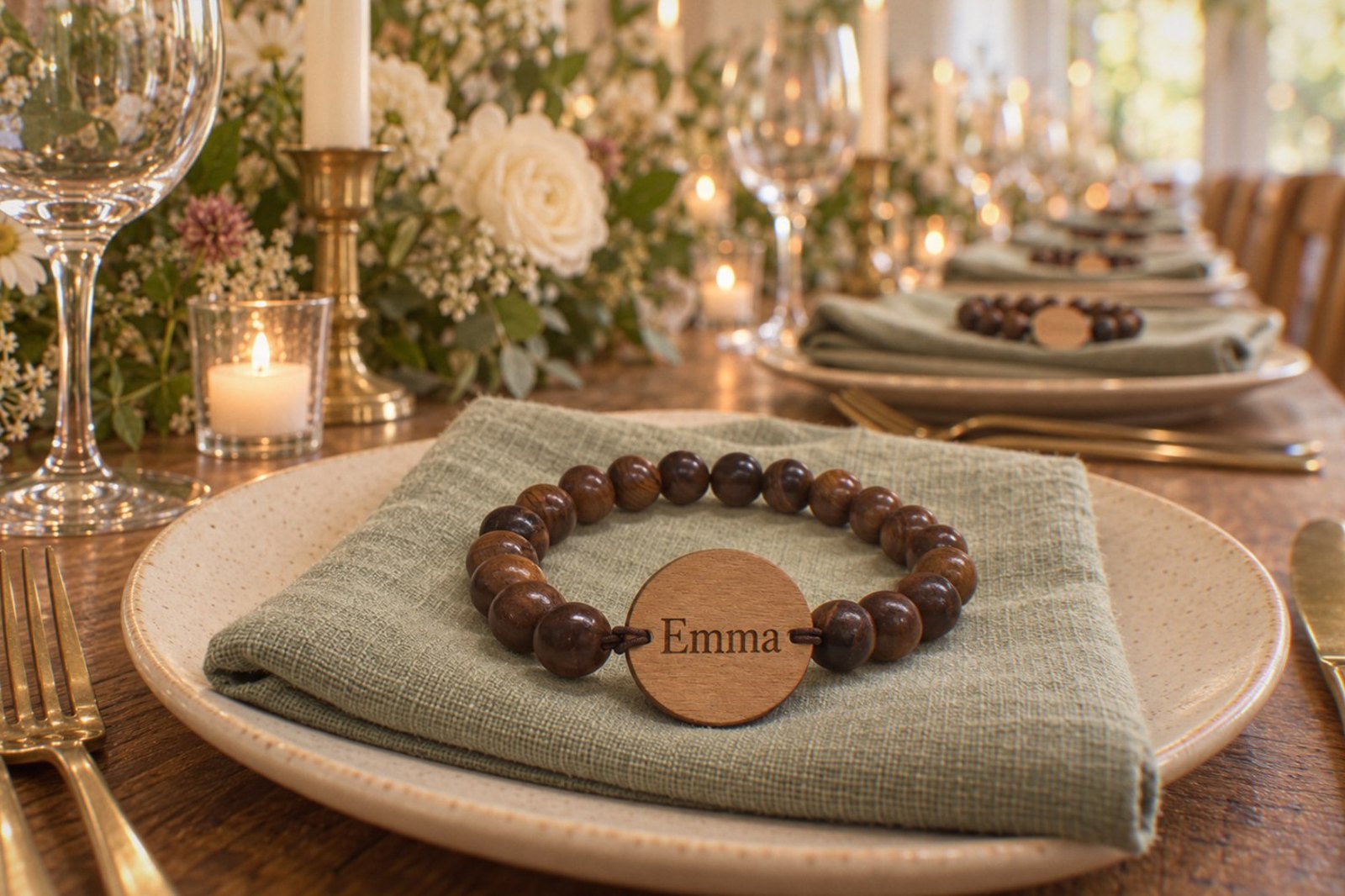
A place card favor is a small gift with a guest’s name on it that marks their seat and then goes home with them. It turns two line items into one, and a favor waiting at a guest’s own seat is the kind most likely to leave with them. A WearableWedding band does both jobs and a third: a guest holds their phone to it and your shared photo album opens.
Place card, escort card or seating chart: what is the difference?
All three tell guests where to sit, at different levels of detail. Wedding publishers such as The Knot and Zola draw the line the same way:
| Item | What it tells a guest | Where it goes |
|---|---|---|
| Seating chart | Every guest’s table, on one display | Near the reception entrance |
| Escort card | One guest’s table | On a display near the entrance, sorted alphabetically |
| Place card | One guest’s exact seat | At the place setting |
You need a way to find the table at almost any wedding with assigned tables, either a seating chart or escort cards. Place cards are optional and mostly appear when seats are assigned, for example when guests have chosen their meal in advance. As event designer Ryan Abney tells The Knot, escort cards are mobile while a seating chart is stationary, which is exactly what lets an escort card become a favor.
Why combine the favor and the card?
Because many couples buy both, for the same guests. In The Knot’s 2026 Real Weddings Study of 10,474 couples, the average couple spent $480 on favors and the average guest count was 117, and The Knot puts day-of paper such as signage and menus at another $150. Zola’s 2026 survey found that 59% of couples planned to give or had given favors, and that more than half of those who had given them spent $5 or less per guest.
A favor with the guest’s own name on it also has a better chance of going home. In planning-forum threads, guests describe leaving behind trinkets printed with the couple’s names and date, and the handful of stories about favors carrying the guest’s own name end with the guest keeping it. No study has measured this, but the stories point one way. And position matters: Joy’s favor guide calls a favor set at each place setting the highest take-rate display of all. We wrote more about which favors guests actually keep.
What does a place card favor cost?
It depends on how much the favor is doing. Here is what each approach costs per guest, from published prices:
| Approach | Per guest | Source |
|---|---|---|
| Printed place cards | $0.69 to $0.99 | Zola and The Knot stationery shops, October 2026 |
| Calligraphed place cards | About $1.50 to $4 | The Knot (from about $2) and calligraphy price guides |
| A typical favor | $5 or less for more than half of couples | Zola 2026 survey of couples who gave favors |
| Engraved wood or acrylic name tags | About $2 to $6 | Etsy and Personalized Favors listings seen October 2026 |
| WearableWedding band | $17.50 to $19.50 at 100 bands; $12 to $14 from 500 | Our pricing page |
A band costs more than a card and a small favor together. The comparison only makes sense if you also count what it replaces beyond the card: a way to collect your guests’ photos and a guest book of their wishes, which many couples otherwise pay for separately. We ran that whole-table math here.
How does a band work as a place card?
- The name. Each band’s wooden tag is laser-engraved on both faces: one side carries the guest’s name, the other your names and date or artwork from our tag design studio.
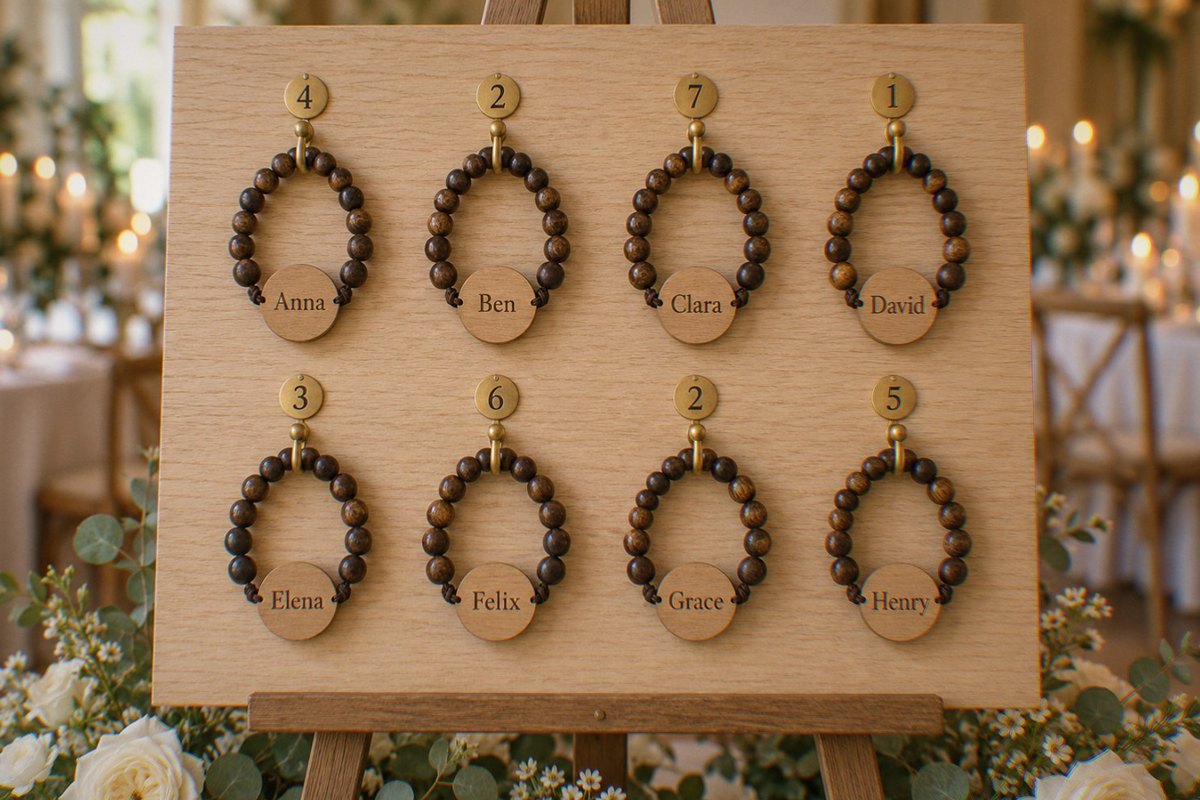
- The seat. Lay each band on its guest’s napkin or plate, name side up. Or hang them, name side out, on an escort display with a small table-number tag on each hook, so guests collect their own on the way in.
- The album. A sealed NFC chip on every band opens your shared album in the guest’s phone browser, with no app and no login, and a printed QR code on the band is the backup.
- The favor. Guests put the band on and wear it home. Bands come in woven cotton or in beads of wood, stone and more, in wrist sizes from XS to XL.
Place setting or escort display?
Both work. The choice depends on whether you assign seats or only tables.
| Compared on | At each place setting | On an escort display |
|---|---|---|
| How guests find their table | A seating chart sign at the entrance | A small table-number tag on each hook |
| Best for | Assigned seats and plated dinners | Assigned tables with open seating |
| How to sort | By table, laid out by your venue | Alphabetically by surname, never by table |
| Outdoors | Heavier than a paper card; in real wind, tuck it into the napkin fold | Hooks keep every band in place |
| Watch for | Guests still need the chart to find the table | Set it where the line can move, not in a doorway |
The Knot, Zola, WeddingWire, Joy and planner Mindy Weiss all recommend alphabetical order: an escort display organized by table makes guests search the whole board for their name, while an alphabetical one keeps the line moving.
How do you get every name right?
- Ask for spellings. Collect names as guests want them engraved, including nicknames, on your RSVP card or website.
- Use full names when first names repeat, so two Rileys never have to guess; the guest list treats two identical names as one person.
- Ask plus-ones for their names rather than engraving “Guest”; a member of the wedding party can quietly find out.
- Give children their own band if they have their own seat.
- One band per person, couples included, because each guest wears their own.
- Order a few spares for late additions, and use your order notes to say how they should be engraved.
With WearableWedding you paste your list, or upload a CSV or Excel file, in your account, review every name, and approve a digital proof before you pay. Nothing is engraved until you have approved it.
When should the names be final?
Engraving is the step that cannot change at the last minute, so plan backwards from it:
| When | What happens |
|---|---|
| 2 to 3 months before | Choose your band design and ask for the current production and shipping time |
| When you set your RSVP date | Leave that production time, plus a week to spare, after RSVPs are due |
| As soon as RSVPs are in | Send your final name list for engraving and approve the proof |
| 1 month to 1 week before | Seating chart finalized: about a month out in The Knot’s and Zola’s checklists, 1 to 2 weeks out in Zola’s seating tool |
| The week of the wedding | Hand bands, place cards and favors to your venue or planner |
The Knot’s usual RSVP date, three to four weeks before the wedding, can be too late for engraved favors: personalized favors commonly need 2 to 3 weeks of production plus shipping, according to Joy’s favor guide. Every band is engraved to order, so confirm the current production time before you set your RSVP date.
Questions
Can a wedding favor be the place card?
Yes. Any small favor with the guest’s name on it can mark a seat or point to a table, and wedding publishers have recommended the two-for-one for years. It saves a line item, and Joy’s favor guide calls a favor set at each guest’s place the display most likely to go home.
Do we still need a seating chart if favors are the escort cards?
No, if the favors hang on an alphabetical escort display with a table number beside each one: the display is your seating chart. If the favors sit at each place setting instead, guests still need a seating chart or escort cards to find their table first.
How early do we need final names for engraved favors?
Earlier than for paper cards. Personalized favors commonly take two to three weeks to produce plus shipping, so ask for the current production time when you choose your design, set your RSVP date to leave that much time, and send the names as soon as RSVPs are in. Engraved items usually have to be ordered before the seating chart is finished, so order a few spares for late additions.
What do we put on the favor for a plus-one whose name we do not know?
Ask for the name. Zola’s etiquette guide suggests getting plus-ones’ names with the RSVP or through a member of the wedding party, calling it much more polite than writing “Guest”.
Do children get their own band?
If they have their own seat, yes. Bands come in wrist sizes from XS to XL, and the drawstring and woven cotton styles close with a sliding knot that adjusts to smaller wrists.
Does every guest need a phone for the band to work?
No. The band is the place card and the favor on its own. A phone simply adds the photo album: held to the band, or pointed at its printed QR code, it opens the album in the browser.
See it live, then design your bands
Open a real demo — no sign-up, nothing to download.
