
Photo sharing
The Wedding Hashtag Is Dead. Here’s What Replaced It.
PureWow’s readers declared the hashtag era ‘resoundingly over’ and planners say couples barely use them. But the job hashtags tried to do, every photo in one place, never went away. What actually works in 2026.
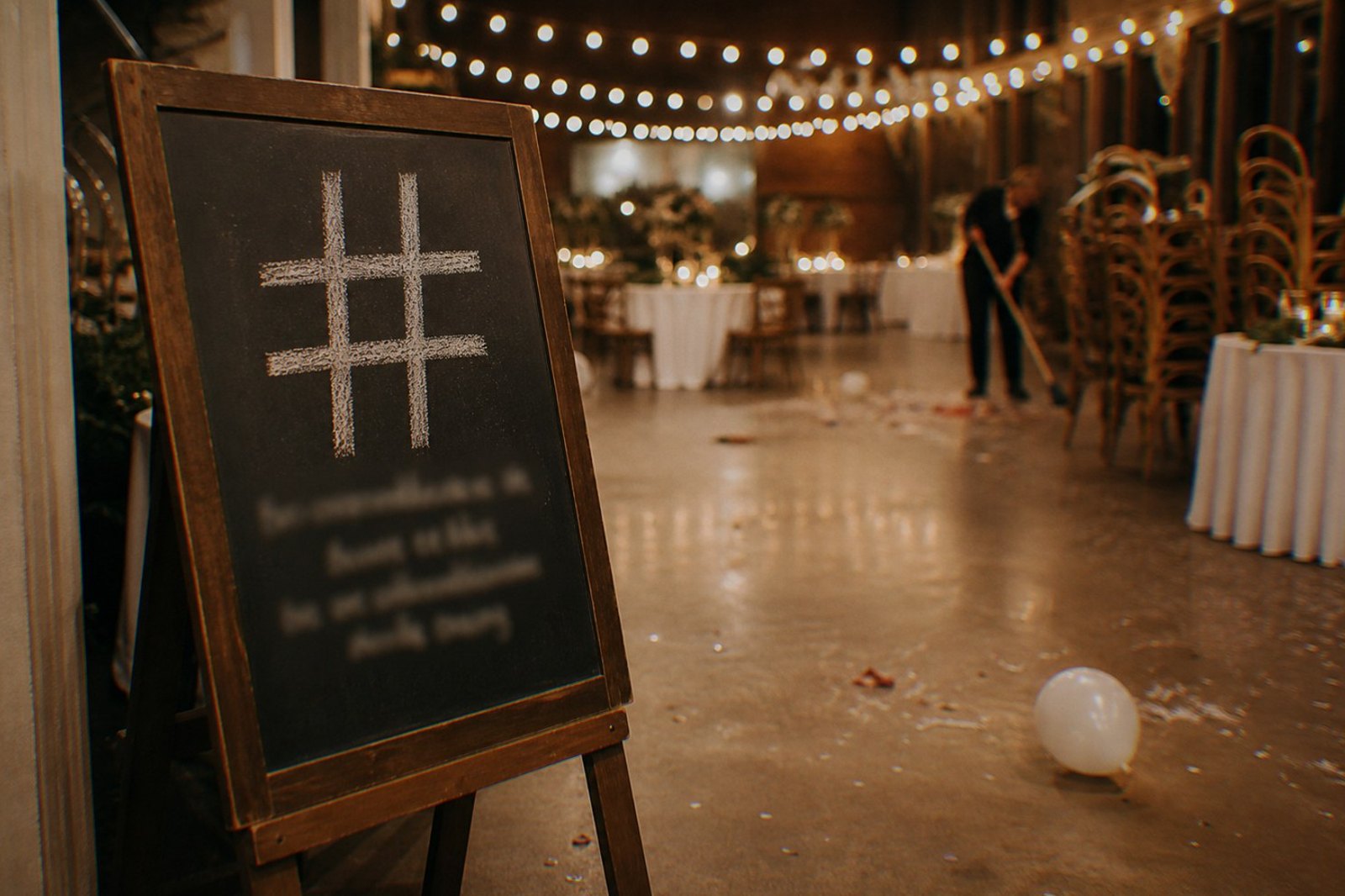
Somewhere in a storage unit there is a box of chalkboard signs that all say the same thing in swooping script: a couple’s names, smashed into a pun, behind a hash mark. #FinallyFitzpatrick. #MeantToBeMcGee. Each one was, for about one afternoon in the late 2010s, the official infrastructure of a wedding’s photo strategy.
We should say the quiet part first: the hashtag was a genuinely good idea. It was the first honest attempt at a real problem, that the people you love take hundreds of photos at your wedding and you never see them. It just solved that problem with the only tool 2015 had, a public social-media index, and the tool has not survived. The evidence is blunt. When PureWow surveyed its readers, more than 85 percent said the wedding hashtag era was “resoundingly over,” three quarters rated hashtags “very 2017,” and Houston planner Shaun Gray summarized the professional view in one line: “Our couples today barely ever use them.”
But buried in that same survey is the number that matters far more than the obituary, and it’s the reason this article isn’t just a eulogy. Half the respondents said the thing they loved about hashtags was having every photo organized in one place. The verdict, read carefully, isn’t “stop collecting photos.” It’s “the collection method failed.” So let’s be precise about why it failed, because the failure is a checklist for choosing what replaces it.
Why the hashtag actually died
The eye-rolls got the press, but mechanics did the killing. Three flaws, each fatal on its own:
It only ever saw public photos. A hashtag collects nothing; it labels things guests were already posting to their own feeds. The overwhelming majority of wedding photos never get posted anywhere. They live and die in camera rolls: the forty candids your college roommate took during the toasts, the getting-ready shots from your sister, the blurry, perfect dance-floor frames. A hashtag never had access to any of it. You got the highlight reel of your most extroverted guests, minus everyone who keeps their accounts private, which by the 2020s was most people.
It scattered instead of gathering. The photos it did catch lived on two or three platforms, under the official tag plus the typo’d variants, mixed with strangers’ posts using the same pun. “Organized in one place” was always the dream; the reality was a scavenger hunt with an expiry date, since platform search gets worse every year.
The ritual aged into self-parody. The pun-generation industry, the fear of a duplicate tag, the sign budget. Survey respondents called the puns “trying too hard,” and once a format becomes a joke about itself, no individual execution escapes.
Notice what’s not on that list: wanting everyone’s photos in one album. That desire is fully intact. It might be the single most universal wish couples express after the wedding, usually in the past tense, usually with regret. We’ve written about how much guest photography simply evaporates, and it’s the problem this entire product category exists to solve.
What replaced it: the 2026 field
Every real replacement shares two design decisions the hashtag got wrong: private by default, and collecting actual files rather than labeling public posts. They differ on the third decision, friction, which is where the interesting comparison lives.
| Method | What it captures | Private? | The catch |
|---|---|---|---|
| Hashtag (the baseline) | Publicly posted photos only | No | Misses nearly everything taken |
| Shared album link (iCloud, Google Photos) | Camera-roll uploads | Mostly | Ecosystem friction; link dies in the group-chat scroll |
| QR gallery service | Camera-roll uploads | Yes | Works only when guests notice the sign; needs MC reminders; typically $30 to $80 and storage that can expire |
| Guest photo app | Camera-roll uploads | Yes | ‘Download an app at a party’ loses half the room |
| NFC tap band (worn) | Camera-roll uploads, plus wishes | Yes | Costs real favor money; the reminder is on the wrist, not on a sign |
The pattern across every row: the method’s success rate tracks how little it asks of a guest at 10 p.m., three drinks in. A link they have to find, a sign they have to remember, an app they have to install, each step sheds participants. The full QR-versus-NFC breakdown runs this in detail, table by table and grandmother by grandmother.
The successor the survey was asking for
Read the survey’s two findings together, 85 percent done with hashtags, 50 percent in love with one-place photo collection, and they describe a product spec: keep the gathering, delete the public feed, delete the effort. Our answer to that spec is the reason this site exists, so consider the source, but here’s how it maps.
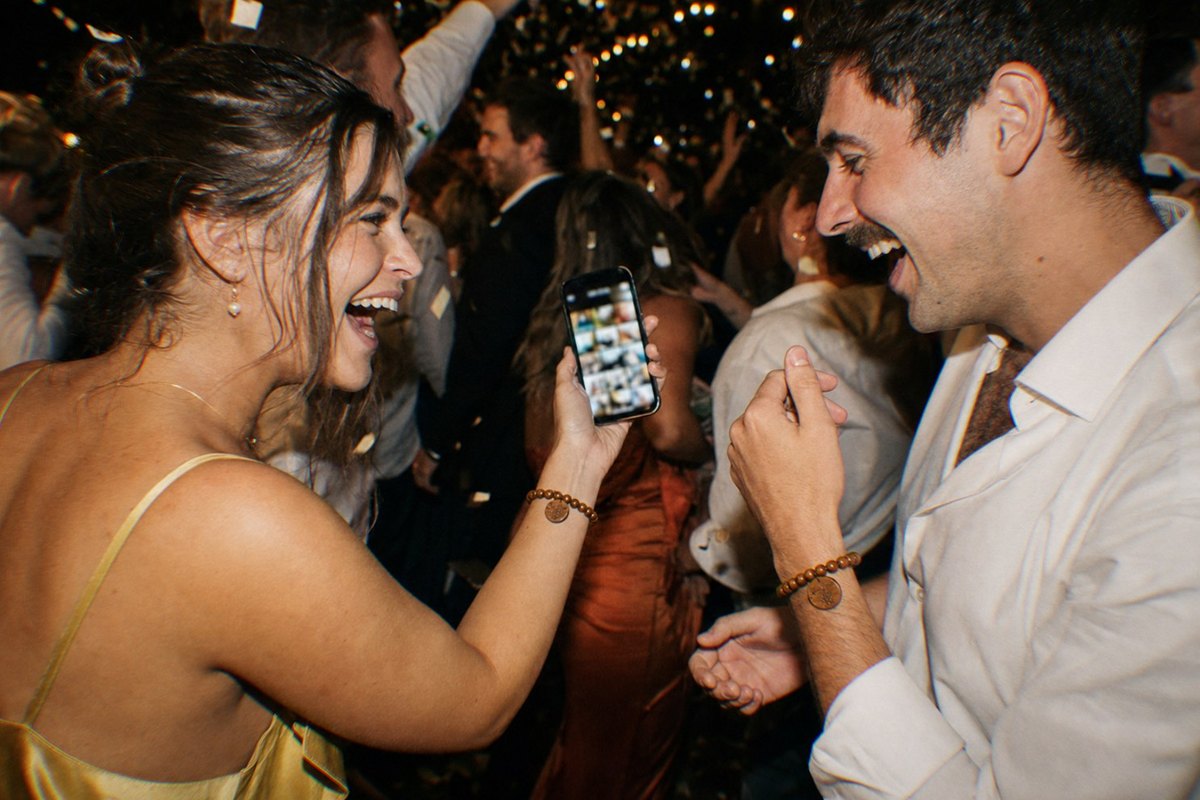
Each guest’s WearableWedding band, cotton or beads picked to match the wedding, carries their engraved name and an NFC chip. One tap with any phone opens the couple’s private album in the browser: no app, no account, no public anything. Photos land at full resolution next to everyone else’s, wishes attach as a built-in guest book, and the couple can put the growing gallery on a screen at the reception, which does the reminding better than any MC announcement, because guests keep seeing their own photos appear.
The hashtag’s one real advantage, zero cost, is honestly conceded: bands are favor-budget money, $17.50 to $19.50 per guest at 100 bands on our tiers. The way to think about that spend is not “an expensive hashtag” but “the favor line and the photo line merged,” which is its own piece of math. The hashtag was free and collected almost nothing. The question is what collecting nearly everything is worth to you.
If you keep a hashtag anyway
No shame in it; a third of couples in Zola’s surveys were still planning one years after the obituaries started, and hashtags retain two legitimate uses. They work fine for the public-by-nature content around the edges of a wedding, engagement announcements, bachelorette posts, anything guests would have posted publicly anyway. And they cost nothing to print on a sign that also carries your actual collection method.
Just don’t confuse the souvenir with the system. The hashtag can be the decoration. Something else has to be the plumbing.
Formats die when their job outlives their mechanism, and that’s the hashtag’s whole story: right wish, wrong decade, wrong plumbing. Guests never stopped taking the photos, and couples never stopped wanting them in one place. The era of asking a public search index to do that work is over. Hand the job to something private, effortless, and ideally already on your guests’ wrists when the good stuff starts happening.
Questions couples ask
Do people still do wedding hashtags in 2026?
Some do, and nothing bad happens to them; surveys through the mid-2020s still found roughly a third of couples planning one. But the momentum is firmly the other way: PureWow’s readers overwhelmingly called the era over, and planners describe them as legacy items, printed on signs and used by almost no one at the actual reception.
What can I use instead of a wedding hashtag?
A private shared album that guests feed directly: via a link on the menu card, a QR sign, or an NFC band each guest wears that opens the album with one tap. All three collect full-resolution camera-roll photos privately, which is everything a hashtag couldn’t do.
Why did wedding hashtags die?
Three mechanical reasons: they only captured the tiny share of photos guests posted publicly, they scattered those photos across platforms and typo’d variants instead of collecting them, and the pun-driven naming ritual aged badly. The desire underneath, one gallery holding everyone’s photos, is as strong as it ever was.
Are wedding hashtags tacky now?
Tacky is strong; dated is fair. Survey respondents used words like ‘very 2017,’ and the pun formats draw the most eye-rolls. If you love yours, keep it for the pre-wedding posts where it still works fine. Just don’t rely on it to collect reception photos, because that part genuinely doesn’t work.
How do I get guests’ photos without a hashtag or an app?
Give them a one-gesture path into a browser-based private album: tap an NFC band or scan a QR code, then upload straight from the camera roll. No account, no download. The methods differ mainly in how much reminding they need, which is where a band worn on the wrist beats a sign on a table.
